
Grilled salmon with fresh herbs, lemon, and a see-through side of a little sassy dog.
~T

Grilled salmon with fresh herbs, lemon, and a see-through side of a little sassy dog.
~T
My adoption of Stella two years ago through the Circle of Hope K-9 Rescue non-profit organization in Milan, Tennessee was a decision made after careful contemplation of the responsibility and financial obligation that pet ownership entails. My want of a home and garden guard dog was a decision that I had contemplated for two years prior to the beginning of my search for her. After a year of futile searching, I was convinced that abandoning my quest for a rescue puppy to adopt was most sensible, and I could get back to the dog-free lifestyle that I was accustomed to living. I decided that I would look one last time on the Pet Finder.com Website before putting the notion of adoption out of my head for good. And that is when I found her:

Being that California allows us to garden all year long, Stella is on daily guard duty. She loves the climate and the work, and is thankful for the loving home we give her. It’s true; I am in puppy love.
 –
–
~T.
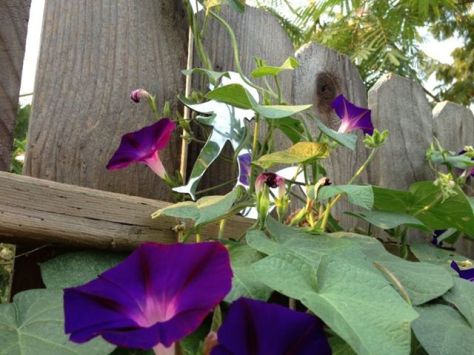
Morning Glory vines cover a six foot section of fence in the Garden’s back yard and discreetly hide my naked Iron Maiden.
~T.
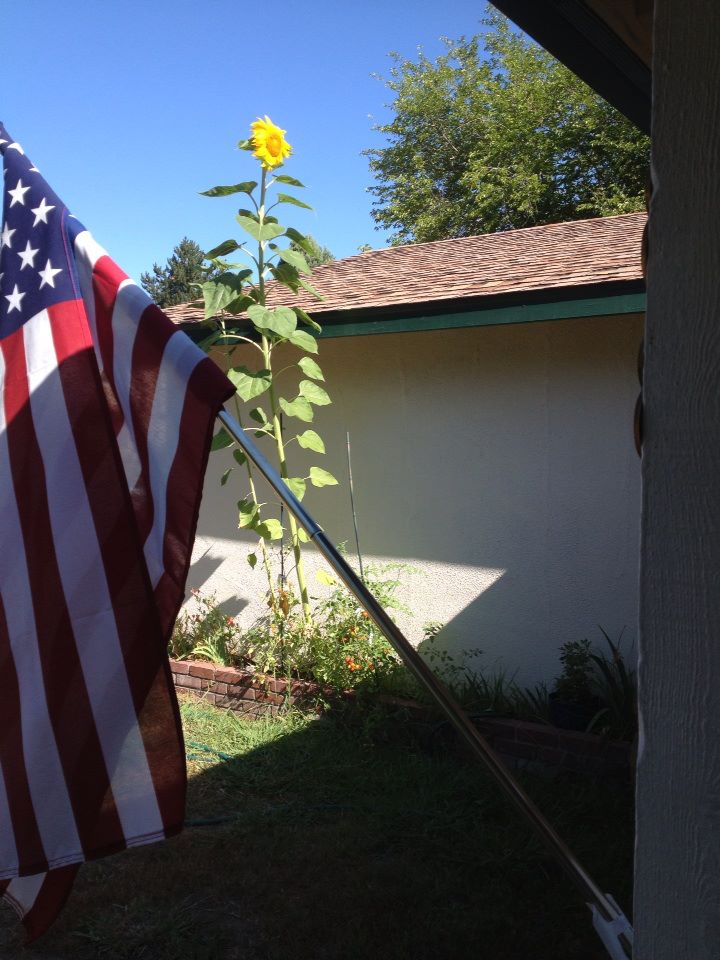
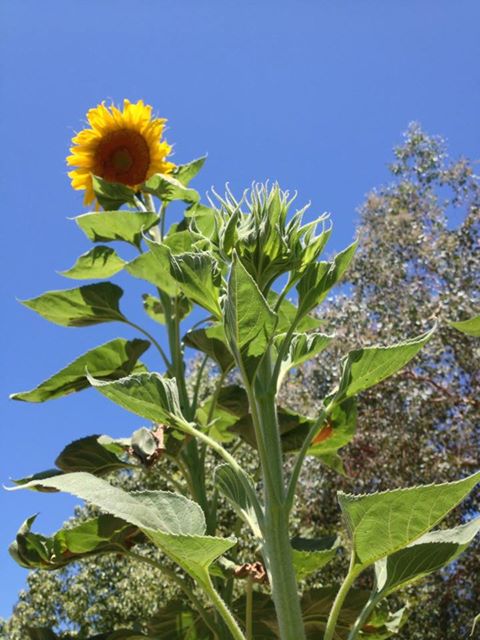
Wild sunflowers are native to North America and were a common crop among American Indian tribes but commercialization of the plant took place in Russia. The Russian Sunflower seeds that we planted in the spring are among the tallest flowers currently growing in our neighborhood. To date, the tallest flower that has graced our landscape measured approximately 14 feet, give or take an inch.
 \
\
~T.
/>
Funk art was inspired by popular culture in the 60’s and 70’s, and uses unlikely mixtures of materials and techniques. Funk artists are not as concerned with impeccable technique, durability or form and so our works are often characterized as having a “sloppy finish”.
My Art Disc Go series have sloppy beginnings and less than sloppy finishes but in the authentic process of making my art, I am at peace and present in those moments of joyful creation.

~T.
There are numerous gardening guides and tips about harvesting fruits and vegetables that you may reference if you have questions about when and how to reap what you’ve sown. Planting, growing, and harvesting your garden is dependent on where you live but there is, most likely, an agricultural extension office and Website that can provide you with loads of appropriate information for the region in which you live.
My current favorite resource comes courtesy of the UC Davis Master Gardening Program: http://cagardenweb.ucdavis.edu/
My instincts and eyesight are usually reliable enough to ensure that I’m harvesting only those vegetables and fruits that have fully matured, and I typically prefer to pick them in the early morning hours between six and nine a.m.
I had to wait until late in the day to harvest last night’s garden treasures but their taste and vibrancy were not adversely affected.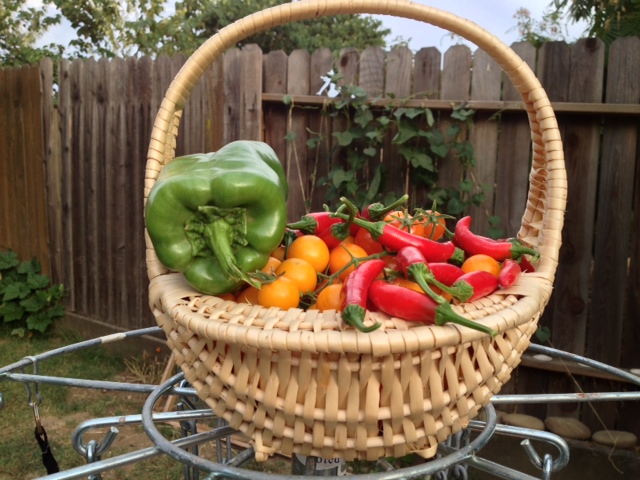
~T.

Three types of phytonutrients found in cucumbers provide us with valuable antioxidant, anti-inflammatory, and anti-cancer benefits. Cucurbitacins, lignans, and flavonoids have been the subject of active and ongoing research to determine the extent and nature of their anti-cancer properties.
We are making two batches of non-fermented pickles with the first harvest of cucumbers that are thriving in our garden, and will savor the flavor of vitamin C, beta-carotene, and manganese that these incredible vegetables provide us.
~T.

Confectionery is broken up into three categories: chocolate, non-chocolate, and chewing gum. A bowl full of non-chocolate goodies picked fresh from our garden is in a category of its own: delicious.
~T.

~T.
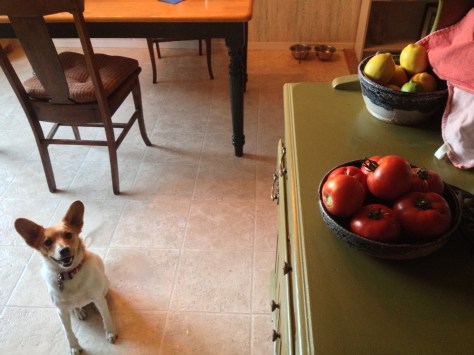
Lycopene is a naturally occurring chemical that gives fruits and vegetables a red color. As you can tell by the photo, our tomatoes are loaded with the stuff. According to the American Cancer Society, a major claim for lycopene’s benefits is in the prevention and treatment of cancers of the lung, prostate, stomach, bladder, cervix, skin, and, especially, prostate. In support of these claims regarding cancer, proponents note that lycopene is a powerful antioxidant, a compound that blocks the action of free radicals, activated oxygen molecules that can damage cells, and that several scientific studies have found lower risk of cancer among people who eat lycopene-rich foods.
The bowl of tomatoes were grown in our garden, and we continue to harvest and eat them daily. With the triple digit heat that is expected to last until the 4th of July, I anticipate that we’ll be eating more of these lycopene rich fruits on a daily basis.
~T.

